Introduction
International trade involves multiple parties, transport modes, customs regulations, insurance requirements, and payment responsibilities. Without clearly defined rules, misunderstandings between buyers and sellers can quickly become expensive disputes.
This is why Incoterms 2020 are critical in global logistics and supply chain management. Published by the International Chamber of Commerce (ICC), Incoterms 2020 define the responsibilities of buyers and sellers during international shipping transactions. These globally recognised trade rules clarify who pays for transportation, who handles customs clearance, who arranges insurance, and when the risk transfers from seller to buyer.
For importers, exporters, freight forwarders, and eCommerce businesses, understanding Incoterms 2020 is essential for reducing operational risks and improving supply chain efficiency.
What Are Incoterms 2020?
Incoterms stands for International Commercial Terms. These are standardised trade rules developed by the International Chamber of Commerce (ICC) to simplify international trade and logistics operations.
Incoterms 2020 help businesses define delivery obligations, freight responsibilities, insurance coverage, customs clearance duties, risk transfer points, and import and export responsibilities.
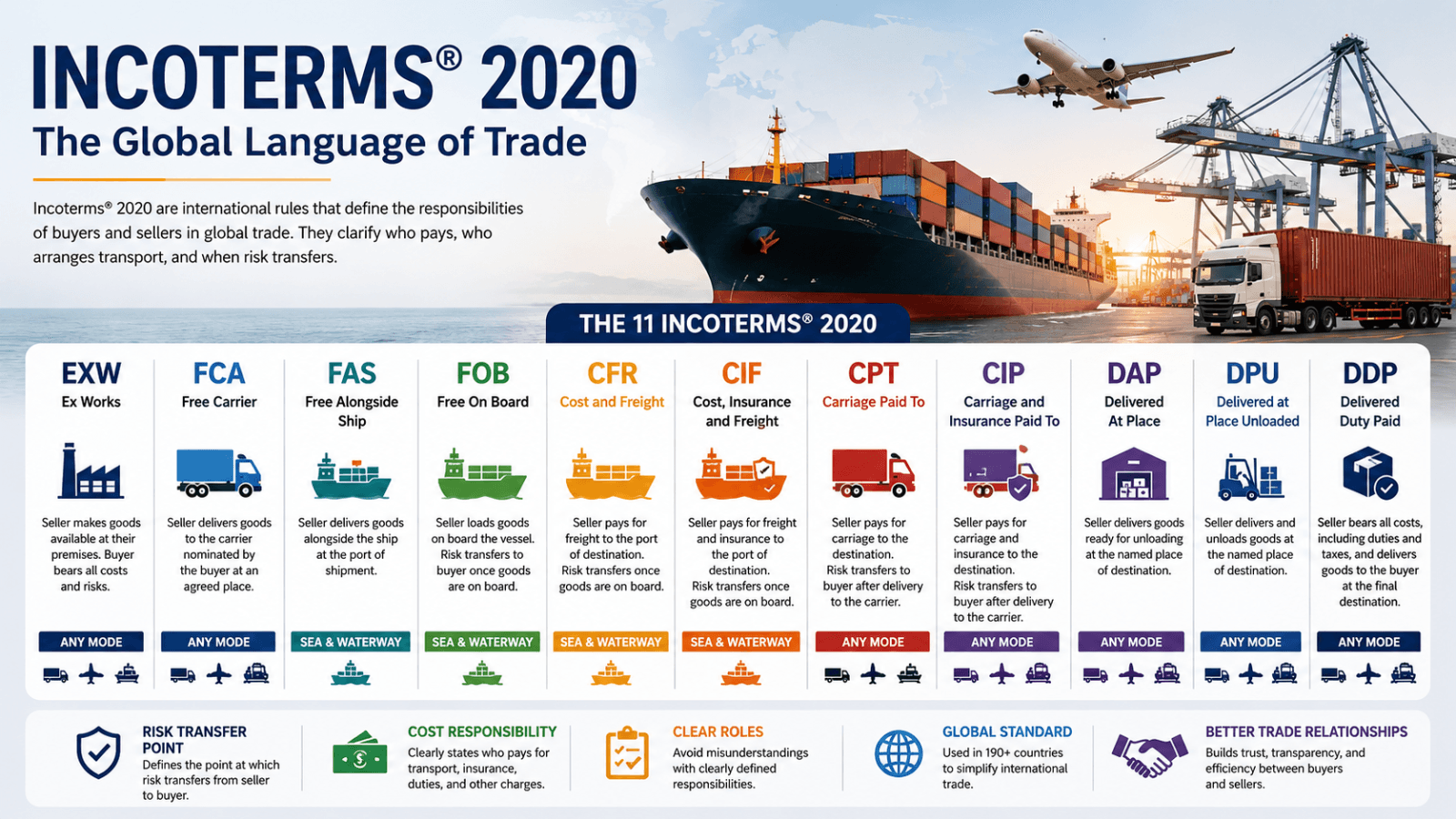
The latest version, Incoterms 2020, officially came into effect on 1 January 2020 and contains 11 internationally accepted trade terms.
Source: https://iccwbo.org/business-solutions/incoterms-rules/
Why Incoterms Matter in Global Logistics
Incorrect use of Incoterms can lead to unexpected shipping costs, delayed customs clearance, insurance disputes, financial losses during transit, supplier disagreements, and cargo liability confusion.
Choosing the correct Incoterm creates transparency across the supply chain and ensures all parties understand their obligations.
For example, FCA is often preferred for containerised cargo, FOB is commonly used for traditional sea freight, and DDP is popular for eCommerce fulfilment and door-to-door delivery.
Businesses involved in international freight forwarding, warehousing, customs brokerage, and multimodal transportation rely heavily on accurate Incoterm selection.
The 11 Incoterms 2020 Explained
Under EXW, the seller makes goods available at their premises, while the buyer assumes nearly all transportation responsibilities and risks. Best for domestic trade, experienced importers, and buyers with strong logistics capabilities. Risk transfers at the seller's warehouse or premises.
Under FCA, the seller delivers goods to a carrier nominated by the buyer at a specified location. FCA is widely recommended for container shipping because it provides greater flexibility and reduces port-related risks. Best for containerised cargo, air freight, and multimodal transportation. Risk transfers when goods are handed to the carrier.
The seller places goods alongside the vessel at the port of shipment. Best for bulk cargo and maritime commodity trade. Risk transfers when goods are placed alongside the vessel.
Under FOB, the seller is responsible until goods are loaded onto the vessel. Best for traditional ocean freight and non-containerised cargo. Risk transfers once goods are onboard the vessel.
The seller pays transportation costs to the destination port, but the buyer assumes risk once cargo is onboard the vessel. Best for ocean freight transactions and bulk international shipments.
CIF is similar to CFR, but the seller also provides insurance coverage during transportation. Best for sea freight requiring insurance protection. Risk transfers once goods are loaded onto the ship.
The seller arranges transportation to the destination, but risk transfers earlier during shipment. Best for air freight and multimodal transport.
The seller arranges transportation and insurance coverage. Incoterms 2020 introduced enhanced insurance requirements under CIP compared to previous versions. Best for high-value cargo and international air freight.
DPU Replaced DAT
Delivered At Terminal (DAT) was renamed Delivered at Place Unloaded (DPU) to allow greater flexibility in delivery locations.
Updated FCA Bill of Lading Rules
FCA now accommodates onboard bill of lading requirements for letter of credit transactions.
Enhanced Insurance Obligations
CIP now requires higher insurance coverage than CIF.
Security-Related Transport Obligations
Incoterms 2020 added clearer guidance regarding transportation security responsibilities.
FCA vs FOB: Which Incoterm Is Better?
One of the most searched logistics questions globally is the difference between FCA and FOB.
Non-containerised cargo
Most logistics experts now recommend FCA over FOB for containerised shipments because containers are usually handed over before vessel loading.
Using FOB for Air Freight
FOB is designed only for sea and inland waterway transport.
Not Defining the Named Place Properly
Businesses should always specify the exact location. Example: FCA Hamburg Port Incoterms 2020.
Assuming Incoterms Cover Ownership Transfer
Incoterms only define delivery obligations and risk transfer — not ownership or payment conditions.
How to Choose the Right Incoterm
The right Incoterm depends on mode of transport, customs expertise, insurance requirements, shipping budget, supplier relationships, and destination regulations.
Businesses should work closely with experienced logistics providers and freight forwarders before selecting Incoterms for international trade contracts. Clarusto supports customs clearance and end-to-end supply chain management to align Incoterms with operational execution.
Final Thoughts
Incoterms 2020 simplify global trade by establishing clear responsibilities between buyers and sellers. Proper use of these internationally recognised trade terms helps businesses reduce shipping risks, improve supply chain visibility, and avoid costly misunderstandings.
As international trade continues to evolve, understanding Incoterms 2020 remains essential for importers, exporters, freight forwarders, and logistics providers seeking efficient and compliant global shipping operations.
Need help aligning Incoterms with your freight and customs workflow? Contact Clarusto Logistics for expert guidance on international trade terms and global shipping execution.
Frequently Asked Questions
What are Incoterms 2020 used for?
Incoterms 2020 define shipping responsibilities, transportation costs, customs obligations, and risk transfer between buyers and sellers during international trade.
Which Incoterm is best for exporters?
FCA is commonly considered one of the best Incoterms for exporters because it offers flexibility and works well with container shipping.
What is the difference between FOB and CIF?
Under FOB, the buyer arranges insurance and freight after goods are loaded onboard. Under CIF, the seller also pays freight charges and provides insurance coverage.
Does DDP include customs duty?
Yes. Under DDP, the seller is responsible for customs duties, import taxes, customs clearance, and final delivery.
Which Incoterm is safest for buyers?
DDP is generally considered safest for buyers because sellers manage most shipping and customs responsibilities.
Can Incoterms be used for air freight?
Yes. FCA, CPT, and CIP are commonly used for air freight shipments.
Are Incoterms legally binding?