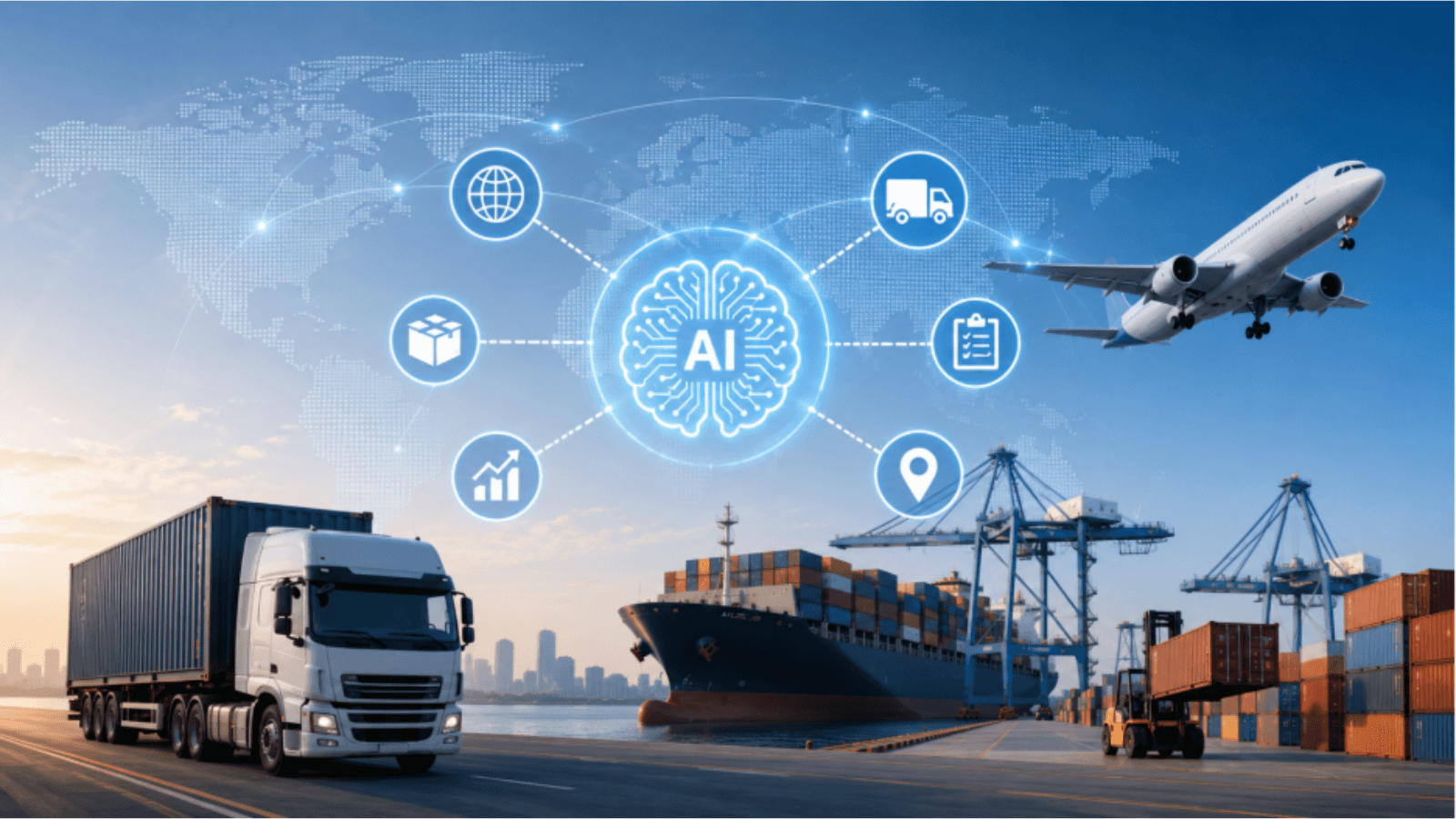
AI in Supply Chain: How Smarter Logistics Is Reshaping UK and Global Trade
Discover how AI is transforming supply chain logistics for UK and global businesses through smarter forecasting, route optimisation, customs accuracy, warehouse efficiency, and real-time shipment visibility.
Editorial Desk
Jun 02, 2026
11 min read
Introduction
Supply chains are no longer judged only by how quickly goods move from one location to another. In today's market, businesses need visibility, resilience, cost control, customs accuracy, faster decision-making, and reliable delivery performance across local and global trade lanes.
For UK importers, exporters, manufacturers, e-commerce brands, and distributors, artificial intelligence is becoming a practical tool for solving everyday logistics challenges. AI in supply chain logistics can help businesses forecast demand, plan routes, manage inventory, reduce delays, improve customs documentation, and create better visibility across the full movement of goods.
The present trade environment shows why this matters. According to the Office for National Statistics, UK Trade: March 2026 was released on 14 May 2026, covering the total value of UK exports and imports of goods and services.
For companies working with international suppliers and customers, supply chain decisions must now be faster, more informed, and better connected. That is where AI-powered logistics can create real commercial value.
The Present Scenario: Supply Chains Need More Than Traditional Planning:
Global supply chains are under pressure from rising costs, changing trade rules, geopolitical disruption, port congestion, customs complexity, customer expectations, and sustainability demands. UK businesses are operating in a trading environment where both local distribution and international freight planning are becoming more complex.
The UK Government's UK Trade in Numbers publication shows that total UK trade in the 12 months to the end of March 2026 was £1,917.3 billion, up 3.7% on the previous 12 months. UK exports were listed at £937.0 billion, while UK imports were listed at £980.4 billion.
This level of trade activity makes efficient logistics essential. A delayed shipment, incorrect customs document, missed delivery window, or stock visibility issue can affect cash flow, production planning, customer satisfaction, and business growth.
Modern supply chain management is moving from reactive problem-solving to predictive planning. Businesses do not only want to know where their shipment is. They want to know what could delay it, which route is safer, how much it may cost, and what action should be taken before disruption occurs.
How AI Is Changing Supply Chain and Logistics
Artificial intelligence helps logistics teams process large volumes of data from orders, warehouses, carriers, customs records, traffic patterns, ports, supplier updates, and customer demand. Instead of relying only on manual tracking and disconnected spreadsheets, AI-supported logistics systems can help businesses make faster and more accurate decisions.
DHL's Logistics Trend Radar 7.0 highlights AI and sustainability as two major trends shaping the logistics sector. DHL notes that AI-related logistics trends include generative AI, AI ethics, audio AI, computer vision, and advanced analytics.
Demand forecasting is one of the most important areas where AI can support supply chain performance. AI can analyse historic sales, seasonal trends, customer behaviour, supplier lead times, market changes, and previous shipment data to help businesses plan stock levels more accurately.
For UK businesses importing from China, Europe, the Middle East, India, or other global markets, better forecasting can improve purchase planning, freight booking, warehouse space usage, and final-mile delivery preparation.
Instead of reacting after stock runs low, businesses can use AI-powered forecasting to plan ahead, reduce emergency shipments, avoid overstocking, and improve customer fulfilment through smarter supply chain management.
Smarter Route Optimisation
Route optimisation is another area where AI is becoming more valuable. AI can compare delivery routes, carrier options, fuel usage, road conditions, traffic patterns, port schedules, weather risks, and delivery windows.
For road freight, AI can help improve vehicle planning and delivery sequencing. For sea freight and air freight, AI can support better routing decisions, carrier selection, and disruption response. For multimodal logistics, AI can help connect air, sea, road, and warehouse operations into a more coordinated supply chain.
Real-Time Supply Chain Visibility
One of the biggest challenges in logistics is lack of visibility. Many companies still depend on separate emails, spreadsheets, manual carrier updates, and delayed tracking information. This creates uncertainty for operations teams and customers.
AI-powered visibility tools can help identify shipment delays, monitor inventory movement, track delivery milestones, and alert logistics teams when action is needed. Visibility also helps businesses manage exceptions more effectively, especially when goods are moving across multiple countries, carriers, ports, and customs checkpoints.
Customs delays can create serious problems for importers and exporters. Incorrect tariff classification, missing documents, valuation errors, incomplete declarations, or late submissions can increase costs and slow down cargo release.
AI can help logistics teams review documentation, identify missing information, improve data consistency, and reduce manual errors. For UK businesses trading globally, customs accuracy is especially important because regulations, tariff rules, border requirements, and compliance expectations continue to evolve.
Clarusto Logistics offers customs brokerage support for importers and exporters, including tariff classification, valuation checks, declaration filing, documentation review, duty optimisation, and clearance delay reduction.
AI and Warehouse Efficiency
Warehousing is becoming more data-driven. AI can help improve stock placement, picking accuracy, storage planning, dispatch timing, labour planning, and order fulfilment.
For e-commerce and retail businesses, warehouse performance has a direct impact on customer satisfaction. A delay inside the warehouse can lead to missed delivery promises, higher customer service pressure, and increased return risk.
AI-supported warehouse systems can help businesses understand which products move fastest, where stock should be placed, when replenishment is needed, and how to reduce dispatch errors.
Why AI Matters for UK Businesses
The UK is strongly connected to international trade. Many UK businesses source products, raw materials, machinery, consumer goods, packaging, industrial components, and specialist equipment from global markets. At the same time, UK exporters need reliable logistics to reach customers across Europe, Asia, the Middle East, North America, and other regions.
According to GOV.UK trade data, UK trade statistics draw on sources including the Office for National Statistics, the Department for Business and Trade, and UNCTAD to show the UK's economic relationship with overseas partners.
For UK SMEs and larger businesses, AI-supported supply chain management can help with reducing avoidable freight delays, improving inventory planning, strengthening supplier coordination, supporting faster delivery decisions, improving customs readiness, reducing logistics waste, increasing shipment visibility, managing risk during disruption, and improving customer communication.
The Rise of Agentic AI in Supply Chain
The next stage of AI in logistics is not only prediction but action. Gartner predicts that by 2030, 50% of cross-functional supply chain management solutions will use intelligent agents to autonomously execute decisions within the supply chain ecosystem.
This does not mean human logistics experts will disappear. It means logistics teams will increasingly use AI assistants to monitor risks, recommend actions, prepare documents, compare route options, manage repetitive workflows, and highlight urgent exceptions.
Local and Global Logistics: Why Both Matter
A strong supply chain needs both local control and global reach. Local logistics helps with UK collection, warehousing, customs coordination, last-mile delivery, returns management, and customer communication. Global logistics supports international freight forwarding, overseas supplier coordination, ocean freight, air freight, multimodal movement, and cross-border trade lanes.
Clarusto Logistics is positioned as a UK freight forwarding and supply chain company providing air freight, sea freight, customs brokerage, supply chain management, last-mile logistics, warehousing, and global logistics support.
AI Will Not Replace Logistics Expertise — It Will Strengthen It:
AI is powerful, but it is only useful when supported by good data, clear processes, trained teams, and reliable logistics partners. Poor data, disconnected systems, unclear responsibilities, and weak communication can limit the value of AI in supply chain operations.
The best logistics strategy combines technology for visibility, people for decision-making, processes for consistency, data for smarter planning, and partnerships for global movement.
Conclusion
AI is becoming one of the most important developments in supply chain and logistics. For UK businesses, it offers a way to improve forecasting, reduce delays, manage customs more efficiently, optimise routes, strengthen visibility, and build more resilient global operations.
As trade remains active and complex, businesses need logistics partners that can combine local UK expertise with global freight capability. Clarusto Logistics supports this direction through freight forwarding, supply chain management, warehousing, customs brokerage, transportation coordination, e-commerce logistics, and delivery visibility.
Looking to improve your supply chain with smarter logistics support? Contact Clarusto Logistics for reliable UK and global freight forwarding, customs clearance, warehousing, transportation, e-commerce logistics, and end-to-end supply chain solutions.
Frequently Asked Questions
What is AI in supply chain logistics?
AI in supply chain logistics means using artificial intelligence to improve forecasting, route planning, inventory management, shipment visibility, customs documentation, warehouse operations, and delivery performance.
How can AI help UK logistics companies?
AI can help UK logistics companies reduce delays, improve transport planning, manage warehouse operations, predict disruption, optimise delivery routes, and give customers better shipment visibility.
Why is supply chain visibility important?
Supply chain visibility helps businesses track shipments, monitor inventory, identify delays early, and make faster decisions. It reduces uncertainty and improves customer communication.
Does AI replace logistics companies?
No. AI supports logistics companies by improving data analysis, automation, and decision-making. Human logistics experts are still needed for planning, customer service, compliance, and complex freight management.
Why choose Clarusto Logistics for supply chain support?
Clarusto Logistics provides freight forwarding, multimodal transport, warehousing, customs brokerage, e-commerce logistics, supply chain management, and delivery visibility for businesses needing reliable UK and global logistics support.