Overview
A warehouse may look like a storage expense. In reality, its location, labour, handling, inventory and connection to transportation can influence the cost of the entire supply chain.
When businesses compare warehousing options, one of the first questions is usually:
"How much is the rent?"
It is an important question — but it is only one part of the calculation.
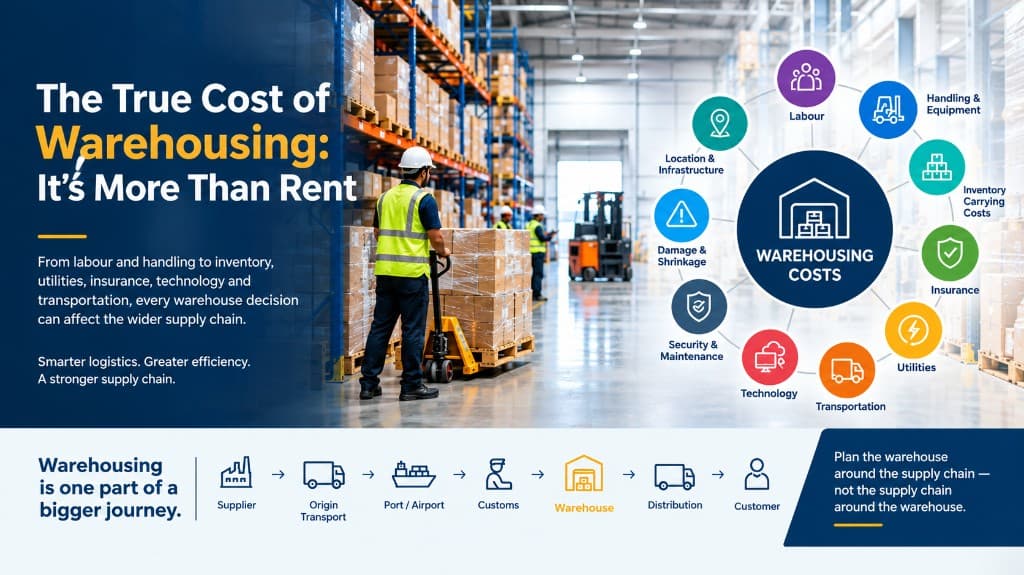
For importers, exporters, manufacturers and distributors, the true cost of warehousing can include labour, handling, equipment, inventory carrying costs, insurance, utilities, transportation, technology, damage and shrinkage.
More importantly, a warehouse does not operate in isolation.
It sits within a wider logistics journey, connecting suppliers, ports, transport networks, inventory and customers.
That means a warehouse that appears economical on paper can potentially create additional costs elsewhere in the supply chain.
What Really Makes Up the Cost of Warehousing?
The Government of India's assessment of logistics costs recognises transportation, warehousing and storage, packaging, insurance and other administrative and operational expenses as components of the wider logistics-cost ecosystem.
This broader view is important.
The cost of warehousing is not simply the cost of occupying a building. It is the cost of storing and moving inventory efficiently through that facility.
Let's look at the major cost drivers.
The most visible cost is the price of warehouse space.
However, businesses also need to consider the facility's location, accessibility, storage capacity, security, infrastructure and ability to scale.
A warehouse closer to a port, manufacturing hub or customer base may have a higher rental cost but reduce transportation distances and delivery requirements.
According to CBRE's India Logistics Market Outlook, demand for quality logistics and warehousing space continues to support activity across established and emerging logistics locations, while occupiers are increasingly considering facility quality and network configuration alongside cost.
- Warehouse Space Is Only the Starting Point
This creates an important distinction
The lowest warehouse rent does not automatically mean the lowest logistics cost.
A warehouse may be a physical building, but its operations depend heavily on people.
Receiving cargo, unloading, checking, labelling, picking, packing, palletising, loading and inventory management all require labour.
But the issue is not simply how many people work in a warehouse.
It is how efficiently they can complete each activity.
An inefficient layout can increase walking distances, create unnecessary movement and add time to every order.
Research from McKinsey on warehouse costs recommends looking at the underlying requirements for space, labour and equipment, rather than relying only on broad warehouse cost benchmarks.
For businesses, that means measuring the cost of the activity — not just the cost of the employee.
Cargo rarely enters a warehouse and remains untouched until collection.
- Labour Is a Major Operating Cost
- Every Additional Handling Has a Cost
A typical shipment may be
Unloaded → inspected → moved → stored → retrieved → picked → consolidated → loaded
Every additional movement requires time, labour and equipment.
Poor warehouse layouts, unnecessary transfers or inefficient picking routes can therefore increase operating costs without increasing the value delivered to the customer.
This is why warehouse design and process planning matter.
The fewer unnecessary touches a shipment requires, the more efficiently it can move through the supply chain.
One of the most overlooked warehouse costs is the inventory itself.
Goods sitting in storage represent capital that has already been committed but has not yet reached the customer.
- Inventory Costs Money Even When It Is Sitting Still
Businesses can also incur costs related to
This makes inventory dwell time an important consideration.
For example, an imported shipment that remains in storage because of a delay in customs clearance or onward transportation can generate additional storage and handling requirements.
The objective should therefore not simply be to maximise warehouse capacity.
It should be to maintain the right inventory in the right location for the right amount of time.
One of the most important connections between warehousing and logistics is location.
- Storage
- Insurance
- Handling
- Inventory management
- Financing
- Damage
- Shrinkage
- Obsolescence
- Location Can Change the Transportation Cost
Consider two facilities
Warehouse A may appear cheaper when comparing rent alone.
But once trucking distance, fuel, driver time, delivery frequency and additional handling are included, the total cost may look very different.
This is why warehouse planning should be connected to the wider transportation strategy.
CBRE's latest India industrial and logistics market data highlights continued logistics demand from sectors including third-party logistics, engineering and manufacturing, reinforcing the importance of strategically positioned logistics networks.
For international cargo, the warehouse decision should therefore be considered alongside ocean freight, air freight, road transportation, customs and final delivery requirements.
Technology is changing how warehouses operate.
Warehouse management systems, automation, robotics, AI-supported planning and real-time visibility can help businesses improve inventory accuracy, productivity and fulfilment.
According to McKinsey's research on AI and digital capabilities in logistics operations, 96% of surveyed shippers had deployed at least one AI or digital use case in warehousing, while 93% planned to adopt four or more of the use cases covered in the research.
But technology is not automatically a cost-saving solution.
The better question is
"Which technology can solve a measurable operational problem?"
For one business, better inventory visibility may deliver the greatest value. For another, automated picking or improved warehouse planning may have a stronger business case.
The warehouse itself also has ongoing operating expenses.
Depending on the facility and type of cargo, businesses may need to account for:
Specialist cargo can create additional requirements.
These expenses may not always appear in the headline storage rate, but they still contribute to the total cost of keeping inventory safely available for its next movement. Appropriate cargo insurance can also form part of the wider risk and cost picture.
There is another cost that can be difficult to see on a warehouse invoice: inventory that does not leave the facility as planned.
Goods can be damaged during handling, misplaced, lost or become obsolete.
Even a small percentage of inventory loss can become significant when cargo volumes or values are high.
That makes inventory accuracy and proper handling more than operational concerns.
They are financial considerations.
Modern supply chains also have to account for uncertainty.
It is to create the right balance between
Cost + Service + Flexibility + Resilience
How Should Businesses Calculate the Real Cost?
Instead of asking only
"How much does the warehouse cost?"
businesses should ask
"What does it cost to move, store and manage each unit through this warehouse?"
Useful measures include
The McKinsey warehouse-cost framework takes a bottom-up approach, assessing the actual requirements for space, labour and equipment instead of relying solely on generic warehouse benchmarks.
This gives businesses a clearer picture of where costs are being generated and where efficiencies may be possible.
- Cost per pallet stored
- Cost per unit handled
- Cost per order
- Labour cost per activity
- Inventory dwell time
- Warehouse utilisation
- Handling frequency
- Damage and shrinkage
- Transport cost to and from the facility
- Technology and equipment costs
- Order fulfilment accuracy
A warehouse is one stage in a much larger journey
Supplier → Origin Transport → Port/Airport → Customs → Warehouse → Distribution → Customer
When these stages are planned separately, inefficiencies can appear between them.
A warehouse may have the right capacity but be poorly positioned for transportation.
Cargo may arrive on time but remain in storage because onward delivery has not been coordinated.
Inventory may be available but difficult to locate because visibility is poor.
This is why integrated logistics planning matters.
Warehousing should connect with freight forwarding, transportation, customs, inventory management and final delivery rather than operate as an isolated service.
The Clarusto Perspective
At Clarusto Logistics, warehousing and distribution form part of a broader logistics approach designed around the movement of cargo from origin to destination.
Clarusto's logistics services span freight forwarding, transportation, customs brokerage, warehousing and supply-chain management, allowing businesses to consider storage as part of the wider logistics journey rather than as a standalone activity.
That perspective matters because
Cargo does not stop moving simply because it has reached a warehouse.
It is waiting for its next movement.
And how efficiently that next movement is planned can influence the final cost, delivery performance and reliability of the shipment.
The Bottom Line
The true cost of warehousing is not the price of the space.
It is the combined cost of storing, handling, managing and moving goods — and how effectively the warehouse connects with the rest of the supply chain.
For importers, exporters and manufacturers, evaluating warehousing through this wider lens can reveal where costs are really being created and where efficiency can be improved.
Because the cheapest warehouse on the quotation may not always be the lowest-cost logistics solution.
Planning your next shipment or looking to optimise your logistics flow? Talk to Clarusto Logistics about your freight, warehousing and supply-chain requirements.
Frequently Asked Questions
What costs should businesses include when calculating warehousing expenses?
Beyond rent, businesses should consider labour, handling, equipment, inventory carrying costs, insurance, utilities, security, technology, damage, shrinkage, transport to and from the facility, and the cost of disruption or poor service. Looking only at the storage rate can understate the true logistics cost.
Why is the cheapest warehouse not always the lowest-cost option?
A lower-rent facility that is poorly located, inefficiently laid out or disconnected from transport and customs planning can increase trucking, handling, dwell time and fulfilment costs. Total landed logistics cost often matters more than the headline warehouse rate.
How does warehouse location affect transportation costs?
Location influences trucking distance, fuel, driver time, delivery frequency and access to ports, airports and customer markets. A higher-rent site closer to major routes can reduce overall transport and handling costs compared with a cheaper but remote facility.
How can businesses measure warehouse performance more accurately?
Useful measures include cost per pallet or unit handled, labour cost per activity, inventory dwell time, warehouse utilisation, handling frequency, damage and shrinkage rates, transport cost to and from the facility, and order fulfilment accuracy. A bottom-up view of space, labour and equipment requirements is often more useful than generic benchmarks alone.
How does Clarusto Logistics approach warehousing?