Overview
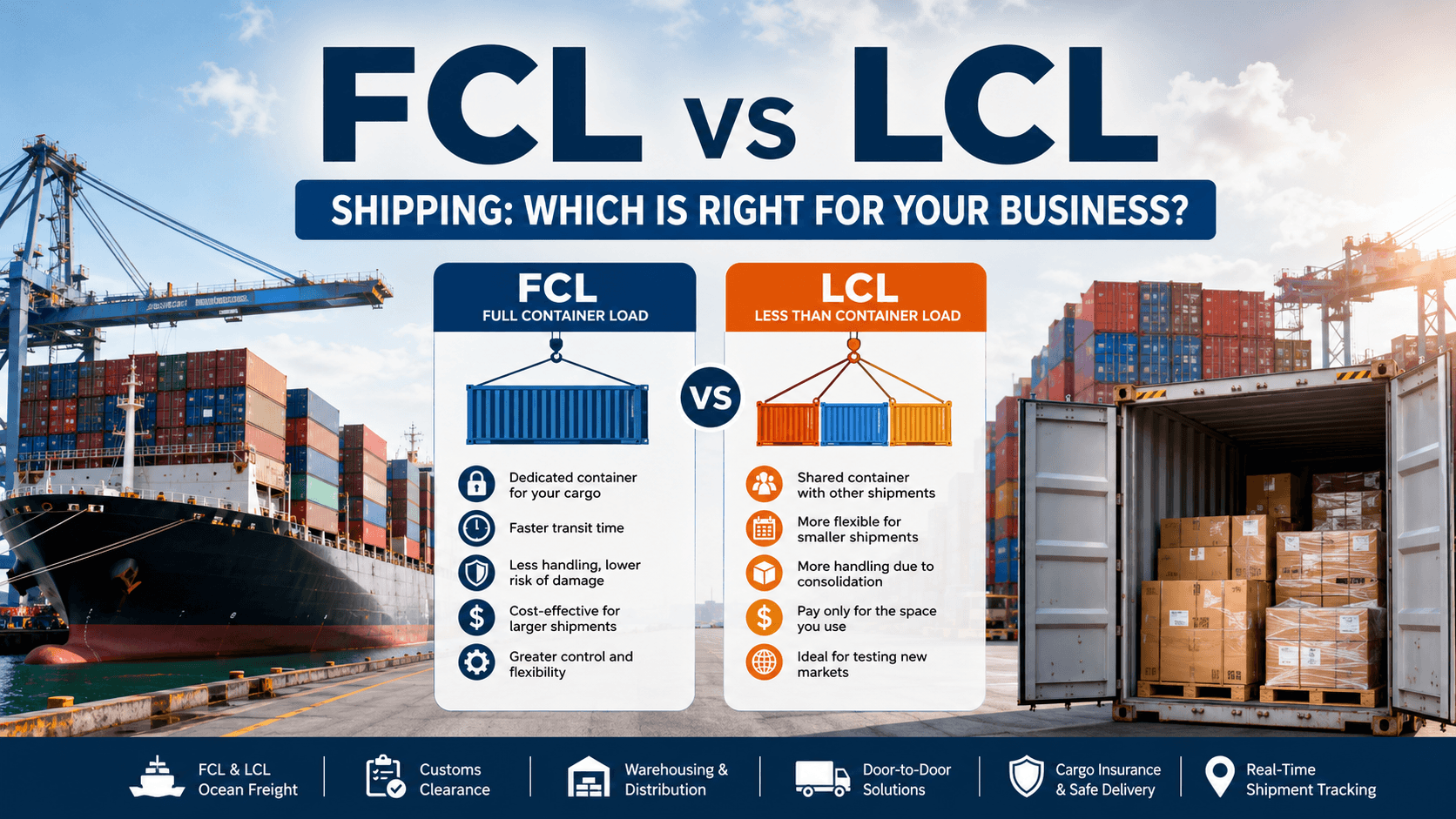
When shipping goods internationally by sea, one of the first decisions businesses need to make is whether to use Full Container Load (FCL) or Less than Container Load (LCL) shipping.
The right choice can affect freight costs, transit planning, cargo handling, customs processes and overall supply chain efficiency. But FCL is not automatically better for large businesses, and LCL is not simply the cheaper option for smaller shipments.
The best solution depends on your cargo volume, delivery requirements, trade lane, handling needs and total landed cost.
What Is FCL Shipping?
FCL (Full Container Load) means a container is allocated to a single shipper's cargo. The container may be 20-foot, 40-foot or another suitable type depending on the cargo and shipping requirements.
An important point is that an FCL container does not necessarily have to be completely full. Businesses can book a dedicated container when having exclusive container space provides operational or commercial advantages.
FCL is generally well suited to
With a dedicated container, cargo does not need to share container space with unrelated consignments, which can simplify loading, handling and delivery planning.
What Is LCL Shipping?
LCL (Less than Container Load) is used when a shipment does not require an entire container. Cargo from different shippers is consolidated into one container and separated again at the destination.
This makes LCL particularly useful for businesses moving smaller quantities that do not justify booking a complete container.
- High-volume shipments
- Regular import and export programmes
- Machinery and industrial equipment
- Automotive and manufacturing cargo
- Cargo requiring dedicated container space
- Shipments where minimising cargo handling is important
LCL can be suitable for
LCL pricing is generally influenced by the shipment's weight and volume, usually measured in cubic metres (CBM), along with origin, destination, handling and other applicable charges.
FCL vs LCL: Key Differences
However, the decision should not be made on freight rate alone. LCL can involve additional origin and destination handling charges, while FCL can become more commercially attractive as shipment volume increases.
FCL vs LCL Cost: Which Is Cheaper?
There is no universal answer.
LCL costs are typically calculated using the weight or measurement (volume) of the cargo, while FCL is generally priced around the container and selected service. DHL Global Forwarding explains that LCL pricing is driven by cargo weight and volume, alongside other applicable charges.
For this reason, businesses should compare the total landed cost rather than simply comparing the ocean freight rate.
- Smaller import and export shipments
- Product samples
- E-commerce and retail replenishment
- Smaller purchase orders
- Businesses entering new international markets
- Shipments where inventory needs to move before a full container quantity is available
- Container space: FCL is dedicated to one shipper; LCL is shared with multiple shipments
- Typical use: FCL for larger-volume cargo; LCL for smaller consignments
- Pricing basis: FCL is primarily container-based; LCL is generally weight/volume-based
- Cargo handling: FCL has fewer consolidation stages; LCL requires consolidation and deconsolidation
A proper comparison should consider
Which Is Faster: FCL or LCL?
FCL can have a transit-time advantage because the shipment does not need to go through the same consolidation and deconsolidation process associated with LCL.
However, actual delivery time depends on the trade lane, vessel schedule, port congestion, transshipment requirements, customs clearance and inland transport.
For businesses working to a strict delivery deadline, the important metric is therefore end-to-end transit time, not simply the advertised ocean sailing time.
Don't Overlook Customs and Incoterms®
Choosing FCL or LCL is only one part of international shipping.
Customs documentation, HS classification, import requirements, duties, taxes and delivery arrangements can all influence the final cost and timeline.
The International Chamber of Commerce (ICC) explains that Incoterms® Rules clarify the responsibilities, costs and risks involved between buyers and sellers in the delivery of goods. The current edition is Incoterms® 2020, which contains 11 trade terms. See our Decoding Incoterms 2020 guide for more detail.
Your chosen Incoterms® Rule should therefore be reviewed alongside the transportation plan so that responsibilities for freight, insurance, customs and delivery are properly understood.
- Origin collection and handling
- Ocean freight
How Clarusto Logistics Helps With FCL and LCL Shipping
Choosing the right container strategy becomes easier when freight planning, customs and inland transportation are considered together.
Clarusto Logistics provides integrated ocean freight solutions covering both FCL and LCL, supporting businesses across major global trade corridors. Its sea freight service includes port-to-port and door-to-door options, customs clearance, cargo insurance and live shipment tracking.
The company's wider freight-forwarding operation coordinates carriers, shipment planning, documentation, compliance checks and milestone tracking, giving businesses a single logistics partner rather than fragmented coordination between multiple providers. Learn more in what a freight forwarder actually does.
Clarusto also integrates ocean freight with air and land transportation, warehousing and fulfilment, allowing businesses to build multimodal solutions around their actual supply chain requirements.
Its customs clearance service covers areas including HS classification, duty calculation, import/export documentation and compliance support, helping businesses address the regulatory side of international shipments alongside transportation.
FCL or LCL: How Should You Decide?
Before booking your shipment, consider these five questions:
The Bottom Line
FCL and LCL are not competing solutions—they are different tools for different shipping requirements.
FCL is generally suited to dedicated container movements and higher or predictable cargo volumes, while LCL gives businesses the ability to move smaller consignments without committing to an entire container.
The smartest choice comes from looking beyond the headline freight price and evaluating volume, handling, transit time, customs, inland transportation and total landed cost together.
If you are unsure which option is right for your shipment, Clarusto Logistics can assess your cargo volume, origin, destination and delivery requirements and recommend an appropriate FCL, LCL or multimodal solution. Contact us to discuss your next shipment.
Frequently Asked Questions
What is the difference between FCL and LCL shipping?
FCL (Full Container Load) means a container is dedicated to one shipper's cargo, while LCL (Less than Container Load) combines cargo from multiple shippers in the same container. FCL generally provides greater control over the container, while LCL is designed for smaller consignments that do not require a full container.
Is FCL cheaper than LCL?
Not always. LCL can be more economical for smaller shipments because you pay for the space used rather than an entire container. However, as shipment volume increases, FCL can become more cost-effective. Businesses should compare the complete landed cost, including freight, CFS, handling, customs and inland transportation, rather than comparing the ocean freight rate alone.
Is LCL shipping slower than FCL?
LCL can take longer because cargo needs to be consolidated at origin and deconsolidated at destination. LCL can typically add around four to five days compared with FCL on the same trade lane, although actual transit times depend on the route, sailing schedule and handling arrangements.
When should I choose LCL instead of FCL?
LCL can be a good option when your shipment is relatively small, you want to maintain lower inventory levels, or you do not need to wait until you have enough cargo to fill a container. The decision should also consider delivery deadlines, cargo characteristics and the total cost of the shipment.
Can a freight forwarder help me choose between FCL and LCL?
Yes. A freight forwarder can compare FCL and LCL based on cargo volume, origin, destination, transit requirements, customs, handling and total landed cost. Clarusto Logistics provides FCL and LCL ocean freight solutions alongside customs clearance, inland transportation, warehousing and wider supply-chain services.