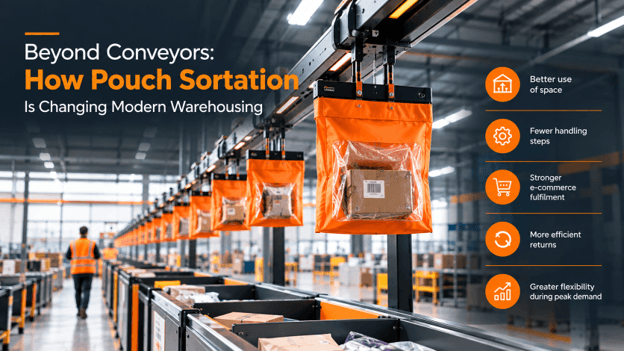
Beyond Conveyors: How Pouch Sortation Is Changing Modern Warehousing
Pouch sortation is changing how modern warehouses move, buffer and sort individual items. Discover how this automated approach can improve warehouse space utilisation, fulfilment, returns and operational efficiency—and where it fits within a connected supply chain.
Editorial Desk
Oct 07, 2026
8 min read
Warehouses are under pressure to process more orders, manage returns faster, use space more intelligently and maintain service levels despite labour constraints. That is pushing businesses to look beyond traditional conveyors and manual handling.
One technology gaining attention is pouch sortation — an overhead system designed to move, buffer, sort and sequence individual items. But what exactly is it, and where can it make a measurable difference to a business?
What Is Pouch Sortation?
A pouch sorter uses suspended pouches or pockets to carry individual products through a warehouse. Items can be identified using technologies such as RFID, then automatically transported, sorted and sequenced towards the appropriate destination.
Unlike conventional floor-based conveyor systems, pouch systems can also make use of overhead space. This can be particularly valuable in warehouses where floor space is already under pressure.
Dematic's Pouch Sorter System overview explains how suspended pouches can handle products ranging from garments and footwear to books and general merchandise, while BEUMER's BG Pouch System overview highlights buffering, sorting and sequencing within one automated system.
The important point is that pouch sortation is not simply another conveyor. It combines movement, temporary storage and sequencing into one process.
Why Is Warehouse Automation Becoming More Important?
Automation is becoming part of a much broader transformation in warehousing.
In September 2026, Gartner's research on AI in warehousing identified physical AI as one of four major trends transforming warehouse operations. Physical AI combines AI, robotics and sensors to support activities including picking, packing, sorting and material handling.
At the same time, DHL's Logistics Trend Radar 8.0 highlights how AI, robotics and automation are changing logistics while emphasising that people remain central to successful supply chains.
That distinction matters. The objective should not simply be "replace manual work with machines." It should be to remove repetitive handling, improve flow and allow people to focus on activities requiring judgement and expertise.
How Can Pouch Sortation Benefit a Business?
1.Better use of warehouse space
One of the biggest advantages is the ability to use space above existing operations.
BEUMER notes that its pouch system can be installed in overhead space, allowing businesses to buffer and sort individual items without consuming the same amount of floor area.
Every additional manual touch can add time, labour and opportunities for error.
Pouch systems can automatically move individual items between processes, reducing unnecessary handling and creating a more controlled flow. BEUMER's 2026 industry outlook also points to scalable, data-driven sortation as businesses deal with fluctuating volumes and ongoing labour pressures.
3.Stronger e-commerce fulfilment
E-commerce orders often contain different products, quantities and delivery requirements. Pouch sortation can help bring individual items together and sequence them for packing.
This makes the technology particularly relevant to fashion, retail, footwear, consumer goods and other operations dealing with large numbers of individual-item orders.
For businesses managing the wider process, Clarusto's e-commerce logistics services cover areas including inbound receiving, inventory control, order fulfilment, pick-and-pack, outbound distribution and returns.
4.More efficient returns
Returns can create significant additional warehouse activity because products must be received, identified, inspected, stored and potentially returned to inventory.
Pouch systems can provide an intermediate buffer for returned items, helping reduce unnecessary movement and manual handling. BEUMER specifically positions pouch technology for both order fulfilment and returns processing.
5.Greater flexibility during demand peaks
Promotions, seasonal sales and e-commerce peaks can create sudden increases in order volumes.
A scalable sortation approach can help warehouses respond without relying entirely on additional manual handling. This is particularly relevant as businesses seek more flexible automation rather than investing in systems designed only for average demand.
Is Pouch Sortation Right for Every Warehouse?
No.
Pouch sortation makes the most sense where there is a significant volume of individual items moving through fulfilment, particularly where businesses face space limitations, complex order profiles or substantial returns.
Potential applications include
E-commerce fulfilment
Fashion and apparel
Retail distribution
Footwear and accessories
Omnichannel operations
Consumer goods
High-volume returns
The right solution depends on the products, order profile, warehouse layout, peak volumes and existing technology infrastructure.
Before investing, businesses should identify the actual bottleneck. If the problem is inventory accuracy, poor slotting or unreliable transport rather than physical sortation, automation alone will not solve it.
The Warehouse Is Only One Part of the Supply Chain
A highly automated warehouse still depends on everything happening before and after it.
International shipments require accurate documentation, customs compliance, appropriate transport modes and reliable final delivery. Clarusto's freight forwarding services connect carrier coordination, shipment planning and documentation, while Clarusto's customs clearance services support import and export compliance.
For international cargo, businesses may also need Clarusto's sea freight services or Clarusto's air freight services depending on urgency, cargo characteristics and commercial requirements.
That is why warehouse automation should be considered as part of the end-to-end supply chain, not as an isolated technology project.
The Bigger Picture
Pouch sortation reflects a wider shift in logistics: businesses are moving towards connected systems that combine automation, data and human expertise.
Gartner's latest warehouse research points towards increasingly intelligent and physical AI-enabled operations, while DHL's 2026 Trend Radar emphasises the growing interaction between technology and the logistics workforce.
For businesses, the question is therefore not simply "Should we automate?"
It is
"Which part of our operation should become smarter, and what business problem will that solve?"
Pouch sortation can be a powerful answer where individual-item movement, space utilisation, fulfilment complexity and returns are creating operational pressure.
But the smartest warehouse is not necessarily the one with the most technology. It is the one where technology, people and the wider supply chain work together efficiently.
Making Warehouse Technology Work for Your Supply Chain
Pouch sortation can help businesses improve how products move through a warehouse, but automation is only one part of a successful logistics operation. The real value comes when warehousing, inventory, transportation, customs and fulfilment work together as one connected process.
At Clarusto Logistics, we help businesses navigate the wider logistics journey — from freight forwarding and customs clearance to sea and air freight, e-commerce logistics and supply chain management. Our focus is on understanding the operational challenge first, then helping businesses build logistics solutions that are practical, connected and scalable.
Whether you are reviewing warehouse processes, managing growing fulfilment volumes or looking for greater visibility across your supply chain, the right logistics strategy can make the difference.
Looking to make your supply chain more efficient and better connected?
Talk to Clarusto Logistics to discuss your logistics requirements and explore how we can support your business from origin to destination.
Pouch sortation is an automated warehouse system that transports individual products in suspended pouches. Items can be identified, moved, buffered, sorted and sequenced to support fulfilment and returns operations.
How does a pouch sorter work?
Products are placed into individual pouches and identified using technologies such as barcodes or RFID. The system then transports and directs each item to the required location, such as a packing station, storage area or returns process.
What are the benefits of pouch sortation?
Pouch sortation can help businesses improve warehouse space utilisation, reduce manual handling, streamline order fulfilment, manage returns and handle fluctuating order volumes more efficiently.
Is pouch sortation suitable for e-commerce businesses?
Yes. Pouch sortation can be particularly useful for e-commerce operations handling large volumes of individual products and complex orders. It can also support processes such as order consolidation and returns.
Can pouch sortation help with warehouse space?
Yes. Because pouches are suspended from an overhead system, the technology can make use of vertical warehouse space and potentially reduce pressure on valuable floor space.
Can pouch sorters handle returns?
Yes. Pouch systems can support returns by transporting and buffering individual returned products before they move to inspection, inventory or another processing stage.
No. Its suitability depends on factors such as product type, order volumes, warehouse layout, fulfilment processes, returns volumes and existing warehouse technology. Businesses should identify their operational bottlenecks before investing in automation.
How does pouch sortation fit into the wider supply chain?
Pouch sortation addresses warehouse movement and fulfilment, but warehouse performance also depends on inventory planning, freight forwarding, customs, transportation and final delivery. For this reason, automation should be considered as part of the wider supply chain rather than as an isolated solution.