Overview
What Is Landed Cost?
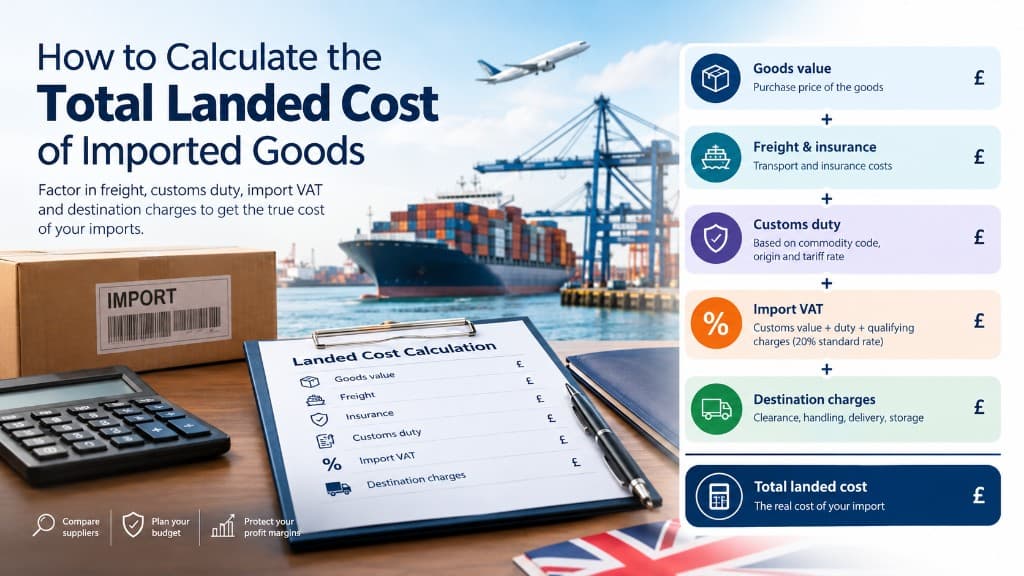
Landed cost is the total cost of purchasing goods and bringing them to a specified destination. It can include the purchase price, transportation, insurance, customs duty, clearance, handling and final delivery.
However, customs value and landed cost are not the same. HMRC explains that customs value is used to calculate customs duty and import VAT, with specific valuation rules determining which costs must be included.
Which Costs Should You Include?
For a clearer view of freight and clearance requirements, explore Clarusto's freight forwarding services and customs clearance services.
How to Calculate Landed Cost: A Worked Example
Consider a hypothetical shipment of 1,000 units imported into Great Britain. The figures below are illustrative, with a hypothetical 5% customs duty rate and a 20% VAT rate. Actual rates depend on the goods and applicable rules.
| Cost component | Amount |
| --- | --- |
| Goods value | £10,000 |
| International freight | £1,000 |
| Insurance | £100 |
| Assumed customs value | £11,100 |
Step 1: Calculate customs duty
- Goods value: Start with the purchase price and identify any additional payments that affect customs valuation.
- Freight and insurance: Include applicable transportation and insurance costs. The amount included in customs value depends on the relevant rules and journey. See also our guide to cargo insurance.
- Customs duty: This depends on the commodity code, customs value, origin and applicable tariff measures. Check the UK Trade Tariff before estimating duty.
- Import VAT: The VAT calculation generally includes customs value, applicable duty and qualifying additional charges.
- Clearance and destination charges: Consider customs declaration fees, terminal handling and other applicable service charges.
- Final delivery and storage: Include onward transportation and relevant warehousing costs.
Assuming the applicable duty rate is 5%
£11,100 x 5% = £555
Check the correct commodity code and duty rate using the UK Trade Tariff. Clarusto's commodity codes guide also explains why accurate classification matters, and our article on HS code errors shows how misclassification can affect margins.
Step 2: Add destination charges
Suppose the shipment incurs £100 in clearance fees, £200 in destination handling and £250 for delivery to the warehouse.
Total additional charges: £550.
Step 3: Calculate import VAT
Assume all £550 in additional charges qualify for inclusion in the import VAT value, alongside the customs value and duty.
Import VAT value = £11,100 + £555 + £550 = £12,205
Assuming a 20% VAT rate
£12,205 x 20% = £2,441
The actual VAT value depends on the nature of the charges and applicable valuation rules. Refer to HMRC's guidance on calculating import VAT.
Step 4: Calculate the total
| Calculation | Amount |
| --- | --- |
| Goods, freight and insurance | £11,100 |
| Customs duty | £555 |
| Destination and delivery charges | £550 |
| Import VAT | £2,441 |
| Total illustrative cash outlay | £14,646 |
If the importer is eligible to recover all the import VAT, the illustrative cost excluding recoverable VAT is £12,205, equivalent to £12.205 per unit for 1,000 units.
This distinction is important: import VAT can affect cash flow without necessarily becoming a permanent business cost. Recovery depends on the importer's eligibility and the applicable VAT rules.
Common Mistakes That Increase Import Costs
- Incorrect commodity codes: Misclassification can lead to inaccurate duty calculations and compliance problems.
- Incomplete freight quotations: Origin handling, destination charges and final delivery may be billed separately.
- Incorrect VAT assumptions: Import VAT may include duty and qualifying expenses beyond the supplier's invoice value.
- Ignoring delivery terms: Confirm which costs and responsibilities belong to the buyer and seller. See our guide to Incoterms® 2020.
- Overlooking storage and delays: Customs checks, missing documentation and missed collections can create additional expenses. Clarusto's true cost of warehousing guide explores why storage and related logistics costs should be assessed together.
How to Improve Your Landed Cost Calculation
Before confirming an order, verify the commodity code and origin, request a detailed logistics quotation, check delivery terms and confirm the applicable customs valuation and VAT treatment.
Compare suppliers using consistent assumptions, allow for unexpected charges and reconcile estimates against final invoices. For complex classifications or tax questions, seek advice from a qualified customs or tax professional.
Plan Your Next Import with Greater Cost Visibility
The supplier's invoice is only the beginning. A reliable landed cost calculation helps you understand the full cost of importing, compare sourcing options and make more informed pricing decisions.
Planning an import into the UK? Talk to Clarusto Logistics about freight forwarding, customs clearance and wider logistics support.
This article is for general information and does not constitute legal, customs or tax advice. Duty, VAT and valuation depend on the specific goods and facts of each import.
Frequently Asked Questions
What is landed cost in importing?
Landed cost is the total cost of purchasing goods and bringing them to a specified destination. It can include the goods value, freight, insurance, customs duty, import VAT, clearance fees and delivery charges.
How do you calculate the total landed cost of imported goods?
Add the goods value, applicable freight and insurance, customs duty, clearance and destination charges, and other relevant costs. Account for import VAT separately where necessary to distinguish total cash outlay from permanent business cost.
How is customs duty calculated in the UK?
Customs duty depends on factors including the goods' commodity code, customs value, origin and applicable tariff measures. Check the UK Trade Tariff to identify the relevant requirements and rates.
Is import VAT included in landed cost?
Import VAT should be considered when calculating the cash required to import goods. However, eligible VAT-registered businesses may recover it subject to the relevant conditions, so it may not represent a permanent cost.
Does freight affect the customs value of imported goods?
Yes. Applicable transport, insurance and handling costs may need to be included in customs value under UK customs valuation rules. The treatment depends on the circumstances of the import.
How do you calculate landed cost per unit?